news
Beyond NIDO: Why Constitutional Continuity Must Guide Nigeria’s Diaspora Governance


By Shakiru K. Oladunjoye, the PRO./AGS. of NIDOE
Beyond Representation: The Case for Constitutional Continuity in Diaspora Governance
Cllr Taslim Gbaja-Biamila has made an important contribution to the current conversation on Nigeria’s diaspora policy. As he observes, Nigeria’s diaspora is far larger, more diverse and more dynamic than any single organisation can represent. He is equally right that a modern diaspora strategy should expand participation, not restrict it.
There should therefore be no serious argument that NIDO alone constitutes the Nigerian diaspora. Nigeria’s professionals, entrepreneurs, academics, investors, researchers, community organisations and millions of individual citizens abroad must all have a place in the national development conversation.
But there is another principle that deserves equal recognition.
The fact that the diaspora is larger than NIDO does not make constitutional governance within NIDO less important. Indeed, it makes it more important.
Cllr Gbaja-Biamila argues that NiDCOM should ensure that no single organisation becomes the gatekeeper of the entire diaspora. That principle is entirely compatible with a second proposition: no individual should become the gatekeeper of a constitutional organisation by authority that the organisation itself does not confer.
This is not about personalities. It is about institutional architecture.
NIDO structures have constitutions, governing organs, electoral processes and defined mechanisms of succession. Where someone claims to hold an office within such a structure, the legitimacy of that claim should derive from the constitution and the process established under it, not merely from personal assertion or external recognition.
This is precisely where the role of the Nigerians in Diaspora Commission becomes important.
Nigeria’s National Diaspora Policy does not make NIDO the exclusive channel for diaspora engagement. It expressly provides for government to work with NIDO and all other relevant diaspora associations including individuals. At the same time, NiDCOM is designated the lead agency and assigned responsibility to co-ordinate and harmonize all continental Nigerian in Diaspora Organizations and to strengthen the existing administrative set-up of NIDO.
That responsibility should therefore be understood not as choosing sides in internal disputes, but as protecting the integrity of the institutional framework.
When competing individuals or groups claim authority over the same constitutional body, the first question should not be whom do we prefer. It should be from where does the claimed authority derive.
Who elected the office-holder? Under which constitutional provision? For what tenure? What mechanism exists for removal or succession? Has that mechanism been followed? And, where litigation exists, what has the court actually determined?
These are not partisan questions. They are the ordinary safeguards of institutional continuity.
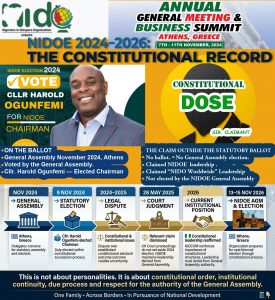
The NIDO Europe experience illustrates why this matters. NIDOE has maintained that its leadership emerged through its constitutional electoral process at the November 2024 Athens AGM, and has continued to operate on that basis following subsequent legal proceedings. The larger lesson, however, goes beyond NIDOE: where a constitutional organisation has an established governance process, competing personal claims should not be permitted to create parallel centres of authority without first resolving the constitutional basis of those claims.
NiDCOM itself has acknowledged the wider problem, describing NIDO as having been plagued by leadership disputes, factionalisation and fragmentation within some of its structures. That observation should invite reflection, not merely criticism.
Fragmentation is rarely created overnight.
It grows when competing claims remain institutionally ambiguous for too long; when recognition comes before verification; and when disputes that could have been clarified through constitutional and administrative engagement are allowed to become entrenched.
NiDCOM’s recent clarification that the body presenting itself as NIDO Worldwide is not duly constituted to speak for all NIDO chapters, together with its advice that government agencies and Nigerian Missions should seek clarification before engaging persons or groups claiming to represent the diaspora, reinforces an important principle: authority must be verified.
That principle should operate prospectively, not only after institutional confusion has become public.
Nigeria’s diaspora strategy should indeed be bigger than NIDO. But it should also be bigger than personalities.
It should be founded on five simple principles:
Engage everyone.
Verify authority.
Respect constitutions.
Protect institutional continuity.
Serve national development.
That is not gatekeeping. It is governance.
And when the ultimate objective is to harness Nigerians abroad for the development of Nigeria, protecting the integrity of legitimate constitutional institutions is not taking sides. It is protecting the architecture through which Nigerians, wherever they live, can continue to contribute to their homeland.
– Written by Shakiru K. Oladunjoye, the PRO./AGS. of NIDOE under the leadership of Hon. Cllr Harold Ogunfemi