

crime
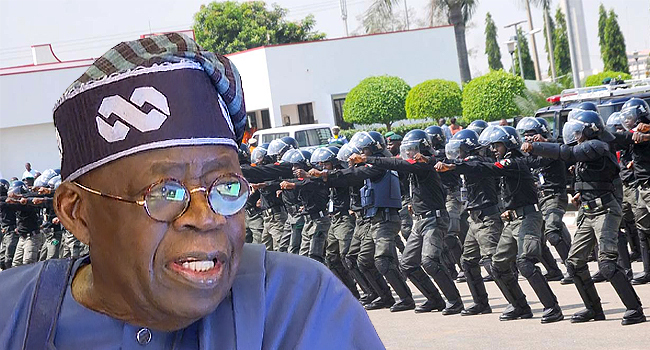
BREAKING: Tinubu Gets State Police Bill, All 36 States Agree, Set To Sign

BREAKING: Tinubu Gets State Police Bill, All 36 States Agree, Set To Sign
Nigeria is now one step away from having State Police.
President Bola Tinubu has officially received the Constitution Sixth Alteration Bill that will create State Police in Nigeria.
This is no longer just talk. It is now on the President’s table for signing.
The announcement was made on Wednesday by the Chief of Staff to the President, Femi Gbajabiamila.
According to Gbajabiamila, the bill was formally handed over to Tinubu by his Special Advisers on Senate and House of Representatives Matters, Senator Basheer Lado and Wasiu Olanrewaju-Smart.
What Will Tinubu Do Next?
Tinubu will not sign immediately.
He will first review the Constitution Alteration Bill in consultation with the Attorney-General of the Federation, Lateef Fagbemi.
After that review, the President will assent to the bill at a formal signing ceremony.
That ceremony is what the whole country is now waiting for.
Once Tinubu signs, the Constitution will be altered to allow State Police.
All 36 States Have Said Yes
This is the part that shocked many Nigerians.
The Clerk to the National Assembly, Kamoru Ogunlana, announced on Monday that all 36 State Houses of Assembly approved the proposed amendment.
Not 24. Not 30. All 36.
The Constitution only requires at least 24 state assemblies to approve under Section 9(2) of the 1999 Constitution, as amended.
The approval went far beyond the minimum requirement. That shows a rare national agreement on security.
Because of that full approval, the bill was cleared for transmission to the President.
Senate Moved Fast
The Senate had earlier directed the Clerk to the National Assembly to transmit the bill to Tinubu for assent.
The directive followed a motion sponsored by the Senate Leader, Opeyemi Bamidele, during plenary on Wednesday.
The Senate also asked the Executive to forward the National Policing Bill to the National Assembly.
That second bill is very important. It will explain how state police will actually work day to day.
Without it, there will be no clear operational framework for subnational policing.
What Is The National Policing Bill?
The National Policing Bill is the rule book for State Police.
It will answer the big questions Nigerians are asking:
Who will control state police, the governor or an independent commission?
How will state police be funded?
How will officers be recruited, trained, and disciplined?
How will state police work with the Nigeria Police Force?
How will abuse of power be prevented?
Gbajabiamila, who is the Chairman of the Presidential Working Group on State Police, said the Working Group has already done extensive work on this.
According to him, the Working Group, with the support of the Policy Advisory Committee, carried out extensive stakeholder engagement and nationwide consultations.
The result is a draft National Policing Bill.
That draft has now been submitted to the Federal Ministry of Justice for legislative drafting validation.
Once the validated version is received, the Working Group will review it and present it, alongside its report, to President Tinubu for consideration.
After that, it will go to the National Assembly for legislative scrutiny and expeditious passage.
Why State Police Matters Now
Nigeria is facing serious security challenges.
Banditry, kidnapping, terrorism, farmer-herder clashes, communal violence, and armed robbery have stretched the central police system.
Many governors have complained for years that they are called Chief Security Officers of their states, but they do not control the police in their states.
Supporters say State Police will bring security closer to the people.
Officers will know the local language, the local terrain, and the local criminals.
Response time will be faster. Intelligence will be better.
Critics say State Police could be abused by governors to fight political opponents.
Others worry about funding and whether poor states can afford to run their own police.
The National Policing Bill is expected to provide safeguards against these fears.
Tinubu Thanks Everyone Involved
President Tinubu expressed his appreciation to the President of the Senate, the Speaker of the House of Representatives, members of the National Assembly, the Clerk to the National Assembly, the 36 State Governors, the State Houses of Assembly, and all Nigerians.
He said they demonstrated a shared commitment to addressing the nation’s security challenges.
What Should Nigerians Expect Next?
Here is the timeline in simple terms:
1. Tinubu has received the Constitution Alteration Bill.
2. Tinubu will review it with the Attorney-General.
3. Tinubu will sign it at a formal ceremony.
4. The National Policing Bill will be sent to the National Assembly.
5. The National Assembly will debate and pass it.
6. States will then begin to set up their own police based on the new law.
Until step 4 and 5 are completed, State Police will not start operating immediately.
But the constitutional door is about to open.
The Big Question For You
Do you support State Police in Nigeria?
Do you think your governor will use it well, or abuse it?
Will State Police make your street, your town, your state safer?
Drop your state and your opinion in the comments. This is your security, your voice matters.
Share this story. Every Nigerian needs to know what is about to change.
Stay with Prestige News for the signing ceremony date, the full details of the National Policing Bill, and what it means for your state.
Follow Prestige News for breaking news, politics, and security updates in Nigeria.









-
 news9 years ago
Osun Government presents 2015, 2016 audited accounts…sets record as the first state in Nigeria to publicly declare accounts
-

 lifestyle7 years ago
Osun CP Pays Alapomu Courtesy Visit
-
 crime6 years ago
Arotile’s ex-classmate had no driver’s licence, report reveals
-
 lifestyle9 years ago
Amazing Tips for an Outstanding Makeup
-
 news6 years ago
2023: Kola Abiola Set To Declare For Presidency
-
 entertainment7 years ago
sanwo-Olu honours sacked chaplain after Ambode’s wife saga
-

 business6 years ago
#EndSARS: Access Bank announces N50 billion interest-free facility for businesses
-
 entertainment7 years ago
See how Women now use toothpaste to tighten vagina